
Carrying the Weight of the World - Carrying Babies with a Biomechanics Focus
Holding a child can be one of the most amazing and intimate experiences that we are able to experience. So why let neck stiffness, arm soreness, and/or low back pain limit the time you get to spend with your bundle of joy? Simple alterations to your and your baby’s posture can optimize the time you spend together while also setting your infant up for the best development possible.
In order to understand how to carry your baby, we have to first understand an infant’s biomechanics and their development over time. In the first six months of life, infants favor the “C-shaped” spinal posture that they experienced in the womb. In this position, the hips should rest in flexion and abduction, or a “frog-leg” like posture (Siddicky et al., 2021). This leg posture favors healthy hip joint capsule development, since the soft tissue structures are not yet strong enough to support the extended leg for long periods of time (Siddicky et al., 2021). After the first six months, the infant’s cartilaginous structures strengthen as they begin to roll from back to tummy and gain the core strength needed to start to sit with support.
How you ultimately decide to carry your baby should be determined by their current muscular abilities and what position is ergonomic for you.
Positioning for Baby - Baby Wearing
In infants 6 months and younger, position baby facing you with their pelvis tucked under them, creating a C shape in their spine. From here, you can bend their knees and place them in a “frog leg” position with support under their thighs.
After 6 months and when your baby has developed significant head control and is able to sit independently, you can try wearing baby on your back in the same that you would use to front carry.
Make sure that the strap or fabric near the infant’s head is supportive and prevents neck extension
Positioning for Parents - Baby Wearing
Make sure that baby’s weight is evenly distributed across your chest, as imbalances will lead to increased use of your back muscles and potential strain
The bottom of the carrier or bottom support strap should be worn high above the hips to prevent forward translation of the low back.
It may be easier to hip hinge forward to position the bottom strap of a baby carrier to position baby optimally before standing back up to position both shoulder straps
When using a cloth or soft baby carrier, make sure it fits BOTH PARENTS - it’s worth the investment for two carriers if there is a significant height difference
Look for carriers that have dual shoulder support to avoid one-sided shoulder pain
Replace bending over to pick up objects from the ground with squatting to avoid excessive back extension
Positioning for Baby - Being Carried
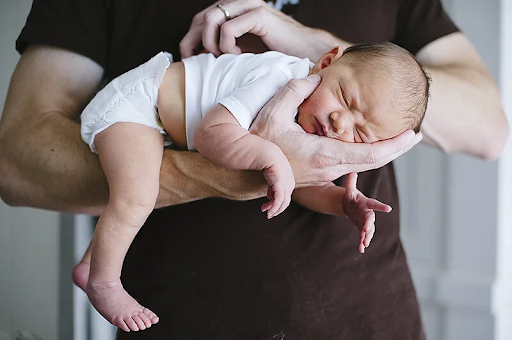
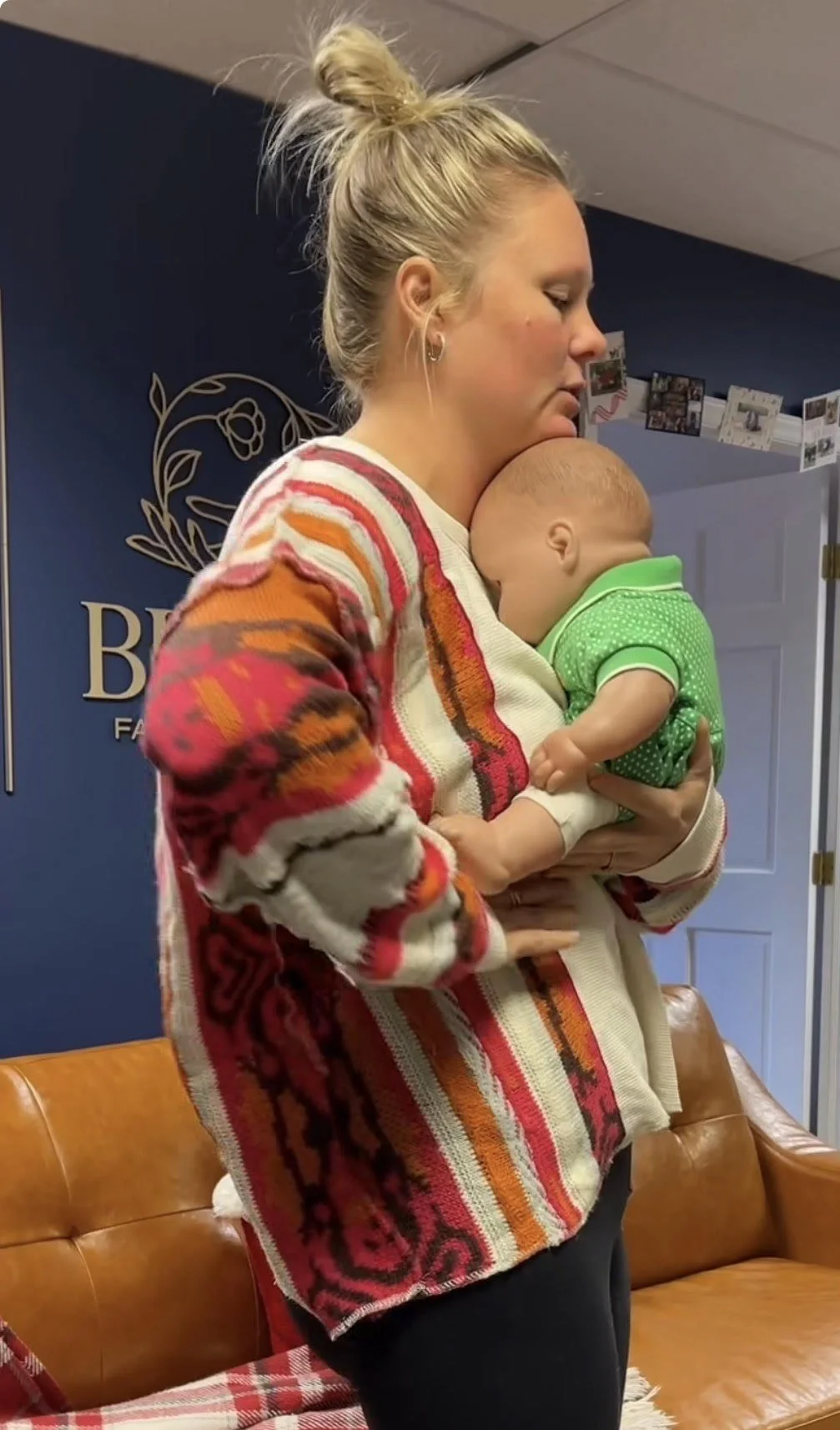
When holding an infant against the chest, the same rules apply as when baby wearing - they should maintain a C-shape spine with their knees bent sitting above the level of their pelvis
When using techniques like the football hold, be sure to alternate which side your baby’s head is turned to in order to avoid head favoring.
An occasional neck tilt can act like a stretch and feel good in a side hold, but try to keep their head and neck parallel to the floor when holding for longer periods of time.
Positioning for Parents - Carrying Baby
Be sure to alternate which side of your body you hold your child on. While using your non-dominant hand can be tricky, it’s important to share the load between both sides of your body to avoid muscle fatigue on one side of your spine (Taboada-Iglesias et al., 2025).
If you’re not multitasking, try to use both arms to hold baby in football or chest-to-chest holds to share the load
When you can, take a seat! Reclining in a chair with low back support and a pillow to support your arms can help bring baby to you without placing strain on your neck

As a parent, it might feel like you have to carry the weight of the world on your shoulders, but these simple modifications to baby holding will save your body the extra stress and allow you to enjoy snuggling with your kiddos for as long as possible.
References:
Siddicky, S. F., Wang, J., Rabenhorst, B., Buchele, L., & Mannen, E. M. (2021). Exploring infant hip position and muscle activity in common baby gear and orthopedic devices. Journal of orthopaedic research : official publication of the Orthopaedic Research Society, 39(5), 941–949. https://doi.org/10.1002/jor.24818
Taboada-Iglesias, Y., Domínguez-Estévez, A., Rodríguez-Gude, C., & Gutiérrez-Sánchez, Á. (2025). Physical and Physiological Consequences of Babywearing on the Babywearer: A Systematic Review. Healthcare (Basel, Switzerland), 13(17), 2193. https://doi.org/10.3390/healthcare13172193